
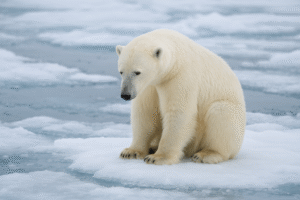
A polar bear’s entire life is tied closely to sea ice.
Hunting:
They are apex predators, relying on sea ice as their hunting ground to catch seals — their main food source.
Raising Cubs:
Sea ice serves as their safe “nursery,” where baby polar bears are born and nurtured.
Migration:
It’s also their “highway” across the vast Arctic region.
But as global warming accelerates ice melt, the polar bears’ habitat is disappearing.
They struggle to find food, and their very survival is at risk.
They’ve become one of the most direct, visible victims — the living evidence — of climate change.
🌍 You Might Wonder — What Does a Polar Bear’s Struggle Have to Do with Us?
This is the butterfly effect of climate change.
When glaciers and ice sheets melt, it triggers a chain reaction:
🌊 Rising Sea Levels:
Coastal cities and low-lying areas face higher risks of floods and land loss.
🌪️ More Extreme Weather:
Melting ice affects global ocean currents and atmospheric circulation, causing more heatwaves, sudden floods, and droughts — even here in Asia.
🌾 Impacts on Agriculture & Economy:
Extreme weather disrupts crop yields, leading to food shortages and higher prices — directly affecting our dining tables and living costs.
🐻❄️ The Fate of the Polar Bear Is the Earth’s Loudest Alarm
It’s a warning that the climate crisis happening far in the Arctic is already quietly reshaping our daily lives and economies along the equator.
SustainaBear Tip:
As businesses, every decision we make shapes the future of our planet.
Driving sustainability and low-carbon transformation isn’t just a trend — it’s the foundation for long-term resilience and competitiveness.
Let’s leave hope — for the polar bears, and for ourselves. 🌱